


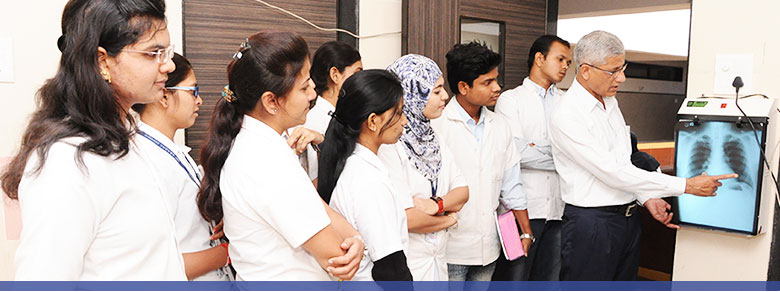
Practice of Medicine is one of the clinical subjects included in undergraduate courses of medical science / Human science carried under medical Universities in different parts of India & world wide.
It is the mother of all the specialties’ as far as medicine is considered. It’s a vast subject and many sister branches / specialties fall under its ambute.
Due to its vastness; with utility to nearabout every practitioner, teacher it plays important part in every ones life.
This subject imparts knowledge with regards to epidemiology, aetiology, C/F, Diagnosis, Investigations, Differential Diagnosis Management of each and every disease entity.
Hence the subject is taught from 3rd BHMS onwards including 3rd BHMS & Final BHMS. The subject matter infused in 3rd BHMS is Respiratory, GIT; immunology, environmental factors, radiation responsible for disease and Genetics responsible for diseaase.
The course matter for 4th BHMS includes CVS, Blood, Genito urinary, Endochronology, CNS,Dermatology, Psychiatry, CTD, Paediatrics, Geriatrics Infectioned tropical, Nutritional & Metabolic etc.
Detailed, systematically planned lessons with regards to the respective class of BHMS is imparted, taking help of audiovisual tools to ensure the grapsing of each & every students.
These students are posed to the practical exposure through regular clinical classes conducted in the well equipped college hospital. Where students actually see the patients and they are trained how to examine, diagnose & how the line of treatment is set.
This is done in the presence of the trained Faculty with ragards to examination, diagnosis & selecting the line of treatment for the patients.
Hence this helps the students to develop the skill of applying theoretical knowledge to practical / clinical aspect of Medicine.
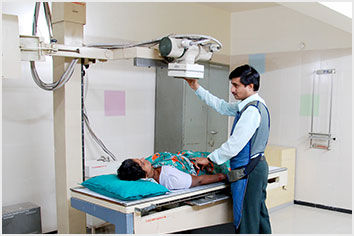
Hospital is well equipped with ECG machine, Pathology lab & X-Ray machine.
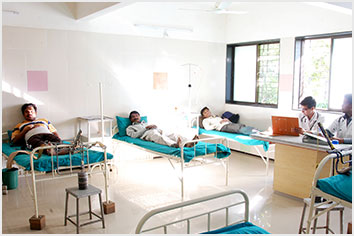
Hospital with in door beds.



-fotor-bg-remover-2023101210531imgFile165277884836ea.png)
imgFile167c2ea554749d-Picsart-BackgroundChangerimgFile169bac53327fda.jpg)



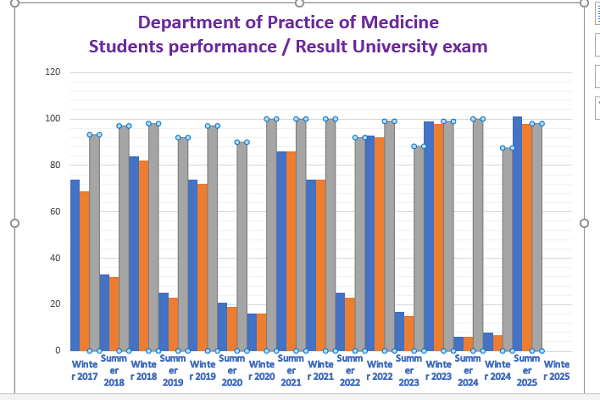
| Month & Year | No. of Student Appeared | No. of Students Passed | % of Result |
|---|---|---|---|
| Summer-2021 | 86 | 86 | 100 |
| Winter-2021 | 74 | 74 | 100 |
| Summer-2022 | 25 | 23 | 92 |
| Winter-2022 | 93 | 92 | 99 |
| Summer-2023 | 17 | 15 | 88.23 |
| Winter-2023 | 99 | 98 | 98.98 |
| Summer-2024 | 06 | 06 | 100 |
| Winter-2024 | 08 | 07 | 87.5 |
| Summer-2025 | 101 | 98 | 98.01 |
| Month & Year of Exam | Name of the Student |
|---|---|
| Winter-2017 | Miss. Prachi Thole |
| Summer-2018 | Miss. Shubhangi Kale |
| Winter-2018 | Miss. Saloni Bhansali |
| Summer-2019 | Mr. Aniket Chaudhari |
| Winter-2019 | Miss. Punam Pawar |
| Summer-2020 | Miss. Sakshi Sankhla |
| Winter-2020 | Miss. Amruta Patil |
| Summer-2021 | Miss. Amrutaben Chaudhari |
| Winter-2021 | Miss. Sejal Lunawat |
| Summer-2022 | Miss. Shraddha Chaudhari |
| Winter-2022 | Miss. Sonal Tripathi |
| Summer-2023 | Miss. Neha Shabir Ahmed |
| Winter-2023 | Miss. Varsha Patil |
| Summer-2024 | Miss. Tejal Wankhede |
| Winter-2024 | Miss. Farheen Sadaf Iqbal |
| Summer-2025 | Miss. Banthiya Dhanashri |


A seminar of Dr. Hetal Kasliwal on topic "Unboxing the difficulties in paediatric case recording, A Homoeopathic Prospect."

A seminar of Dr. Hetal Kasliwal on topic "Unboxing the difficulties in paediatric case recording, A Homoeopathic Prospect."
|
Sr.No. |
Name of faculty |
Achievement |
|
1 |
Dr N V Dhawankar |
Expert (Homoeopathy) clinical meet of AYUSH department of MUHS on respiratory disorders (online) |
|
2 |
Dr M A Potdar |
Cleared the MUHS Ph.D. entrance exam |
|
3 |
Dr Shalini R Ranjan |
Cleared the MUHS Ph.D. entrance exam Secured 1st rank |
|
Year |
Name of faculty |
Achievement |
|
Feb 2020 |
Dr Prasad G Kapadani |
MUHS 6th Rank certificate course modern Pharmacology |
|
May 2021 |
Dr N V Dhawankar |
Awarded Ph.D. Hom |
|
2022 |
Dr Prasad G Kapadani |
Elected Vice president Chandwad Medical association |
|
May 2022 |
Dr M A Potdar |
Cleared the MUHS Ph.D. entrance exam |
|
May 2022 |
Dr Shalini M Sharma
|
Cleared the MUHS Ph.D. entrance exam Secured 1st rank |
|
May 2023 |
Dr N V Dhawankar |
Expert (Hom) clinical meet of AYUSH department of MUHS on respiratory disorders (online) |
|
Sep 2023 |
Dr M A Potdar |
Advanced Research Methodology workshop |
|
July 2025
|
Dr M A Potdar |
National Teachers Eligibility Test |
|
Dr Shalini M Sharma |
National Teachers Eligibility Test |
|
|
Dr Nilesh R Deore |
National Teachers Eligibility Test |
|
|
Jan 2025 |
Dr Nilesh R Deore |
AIHSAYA Academic Award |
|
Aug 2025 |
Dr Nilesh R Deore |
Resource person- “Nephrolithiasis through lens of Homoeopathy” AIHSAYA |
|
Sep 2025 |
Dr N V Dhawankar |
Advanced Research Methodology workshop |
|
Dr Shalini M Sharma |
||
|
Dr Nilesh R Deore |
||
|
2025
|
Dr Prasad G Kapadani |
Kopargaon Medical Association-Guest Speaker on Thyroid complaints |
|
Dr Prasad G Kapadani |
“Hahnemann Puraskar” Nashik District Homoeopathic Association |
Departmental Library is for the ref. of books for the department which includes more than 114 books.

A Motivational session on Research was conducted by Dr. Nilesh Dhawankar on 06/12/2022
Dr. M. A. Potdar attended Advance Course in Research Methodology held from 08/09/2023 to 13/09/2023 at Kakasaheb Mhaske Homoeopathic Medical College, Ahmednagar.

Lecture on Simplified Homoeopathy in Acute Cases by Dr. M. A. Potdar at KMHMC, Ahmednagar on 12.09.23

|
Sr.No. |
Name of journal |
Staff |
Type of article |
Topic |
Date / ISSN |
|
Asian Journal of Homoeopathy |
Dr N V Dhawankar |
Research |
“Chelidonium Majus as Spasmolytic/Muscles relaxant in renal colic” |
ISSN:0975-4156; vol 7No. 2(23) Date: May 2013-july 2013 |
|
|
The Homoeopathic Heritage Peer reviewed journal |
Dr N V Dhawankar |
Research |
“Homoeopathic treatment in Renal colic; an observational open trial, unicentric non-comparative, prospective study” |
ISSN:9070-6038, vol:42, No 11 Feb2017 |
|
|
Materia Novum The journal of Homoeopathy |
Dr Mrs. M A Potdar |
Research |
“Role of Homoeopathic Medicine in case of Leucorrhea- A case report |
Vol-2 issue-4 October-December 2018 |
|
|
Journal of integrated standardized Homoeopathy |
Dr Mrs. S M Sharma |
Research |
“Application of Boger’s approach in case of Ventricular arrhythmia” |
ISSN 2581-947X Vol.02 (1) 2019 |
|
|
KBA’s MISSION |
Dr. Nilesh Deore |
Case Series |
To evaluate the scope of Homoeopathy in, management of Tinea Corporis |
Volume 2 N0.1 Jan-March 2022 ISSN 2582-9408 |
|
KBA’s MISSION |
Dr. Nilesh Deore |
Case Report |
Nux Vomica in Acne Vulgaris: A Case Report
|
Volume3 No.1 Jan-March 2023 ISSN:2582-9408
|
|
Kba's Mission
|
Dr Mrs. M A Potdar |
Case Report |
"Role of Constitutional Homoeopathic Treatment in Primary Dysmenorrhea: A case Report |
Apr-June 2023 ISSN 2582-9408 |
|
KBA’s MISSION |
Dr Mrs. M A Potdar |
Case Report |
Management of Cervical Spondylosis with Individualized Homoeopathic Medicine: A Case Report |
Volume 3 N0.4 October- December 2023 ISSN 2582-9408 |
|
Know Homoeopathy Journal
|
Dr. Nilesh Deore |
Case Report |
A Case of Allergic Dermatitis with Hypothyroidism-An Evidence Based Case Report
|
Volume 4 Issue 2 (October 24) ISSN: 2583-2158
|
|
IJIRT |
Dr Mrs. M A Potdar |
Case study |
The Therapeutic Role of Rhus Tox in Management of Herpes Simplex Virus Infection: A Prospective case series study. |
ISSN 2349-6002 JANUARY 2025 |
|
Journal of neonatal surgery |
Dr Mrs. M A Potdar Dr Mrs. S M Sharma
|
Case study |
Post viral myalgia & the scope of Homoeopathic interventions: A review of clinical outcomes |
Vol.14 Issue 32, ISSN 2226-0439 July 2025 |
|
KBA’s MISSION |
Dr N V Dhawankar |
Clinical study |
“Molecular Mimicry Meets Miasmatic Theory” A clinical study o Homoeopathic Management of Recurrent Pharyngitis in Children |
Vol.5No. 3 Month: July – September 2025 |
|
World Journal of Pharmaceutical and Medical Research International Journal
|
Dr. Nilesh Deore |
Case Report |
Evidence-based homoeopathic intervention in herpetic geometric glossitis: a case report of holistic healing
|
Volume 11 Issue 9 (Sept 25) ISSN (O)2455-3301 ISSN (P) 3051-2557 |
|
Know Homoeopathy Journal
|
Dr. Nilesh Deore |
Case Report |
To Evaluate the effectiveness of Nux Vomica and Berberis Vulgaris in the management of renal calculi-An Evidence Based Report
|
Volume 5 Issue 2 (October 25)
ISSN 2583-2158
|
|
International Journal of Innovative Research InTechnology
|
Dr. Nilesh Deore |
Case Report |
An individualized homoeopathic approach in the management of tinea corporis: a case report
|
Volume 12 Issue 8, January 2026
ISSN 2349-6002
|


Course Outcome (UG)
Homoeopathy has a distinct approach to the concept of disease.
It recognizes an ailing individual by studying patient as a whole rather than in terms of sick parts.
Hence it emphasizes the study of the man, in state of health and state of illness.
The study of above concept of disease is achievable only when the illness is studied or taught in manner which depicts the diseased condition in following attributes:
The diagnosis of the disease is sorted out so as to develop the understanding in the students about the disease and its origin. This allows the student to explore the history of disease in patient and his or her family.
Hence this helps the student to correlate the history to the case in hand in more comprehensive and convincing manner.
In course outcome section as far as 3rd BHMS is concerned, we impart thorough knowledge to the students, as per the syllabus prescribed. This work is divided categorically as under:
Respiratory, GIT diseases, Hepatobilliary diseases, Genetics, Immunology, Environmental factors and disorders related to electrolyte imbalances. Additionally the knowledge of clinical examination of the above mentioned system is been dealt with in clinical classes.
Similarly the syllabus of 4th BHMS is also being also catered with all the theoretical and clinical aspect as mentioned bellow:
Nutritional and metabolic disease, blood, endocrinal disease, infectious disease, cardiovascular disease, urogenital disease, central nervous system, rheumatology, STD, tropical disease, pediatrics, geriartrics. This knowledge is supported by the clinical exposure of students to cases seen in clinics in clinical classes.
The above curriculum of 3rd and 4th BHMS is achieved in prescribed time ascribed by the CCH and competent authorities as follows:
For 3rd BHMS theory hours to be conducted are 75 hours and 75 hours of practical is to be engaged.
For 4th BHMS theory of 180 hours and 75 hours of practical is to be engaged.
Course Outcome (PG)
Homoeopathy has a distinct approach to the concept of disease. It recognizes an ailing individual by studying patient as a whole rather than in terms of sick parts.
Hence it emphasizes the study of the man, in state of health and state of illness.
The study of above concept of disease is achievable only when the illness is studied or taught in manner which depicts the diseased condition in following attributes:
In course outcome section as far as PG is concerned, we impart thorough knowledge to the students, as per the syllabus prescribed. This work is divided categorically as under:
Respiratory, GIT diseases, Hepatobilliary diseases, Genetics, Immunology, Environmental factors and disorders related to electrolyte imbalances. Additionally the knowledge of clinical examination of the above mentioned system is been dealt with in clinical classes. Nutritional and metabolic disease, blood, endocrinal disease, infectious disease, cardiovascular disease, urogenital disease, central nervous system, rheumatology, STD, tropical disease, pediatrics, geriatrics. This knowledge is supported by the clinical exposure of students to cases seen in clinics in clinical classes.
The above curriculum of PG is achieved in prescribed time ascribed by the CCH and competent authorities as follows.
The PG student is exposed to the student of UG through the activities of lectures which are assessed by the competent subject expert as per the PG curriculum.
They are also exposed to the research activities in the field of medicine so as to promote the research in more convincing manner with the help pf THRSIS work on topics which are challenging for the Homoeopathic field and of good help for the patients.
Program Specific Outcome (U G)
Here the overall assessment of the student at the end of the course is inferred. As far as medicine is concerned the following specific course outcome is expected from passing out UG student:
Program Specific Outcome (PG)
Here the overall assessment of the student at the end of the course is inferred. As far as medicine is concerned the following specific course outcome is expected from passing out PG student:
 ATP
ATP